So you want to know, "What is a pressure sensitive label?" Are they stickers, product identifiers, labels or a component of brand packaging? Yes! Pressure-sensitive labels are used everywhere from toys, food containers, durable products, medical devices, and corrugated boxes, to craft beer can and bottles, cannabis containers, plastic pouches and so much more.
But what are they?
Let's break it down...
A pressure-sensitive label, or self-adhesive label, is made up of three layers: a face stock, an adhesive and a release liner. We refer to this as the "label sandwich." When a label is manufactured, these three components are sandwiched together to create a label material that can be printed on, laminated, die-cut, and finally peeled off and applied to your product.
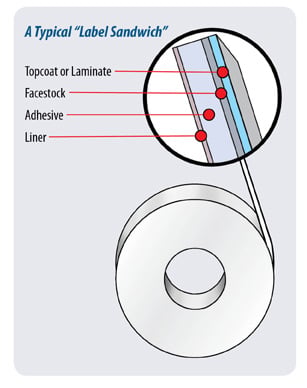
Facestock
The facestock is the main part of the label. The material could be paper, film, or metallic foil. This is the layer where the ink is applied on press. For specific applications, a topcoat or laminate may be applied to protect the label artwork or enhance certain areas of the design.
Adhesive
The adhesive is what makes the label stick to the surface of the product or packaging. For glue-applied (cut & stack) labels, this process happens as the label is being applied. A pressure-sensitive label is manufactured to have the adhesive already applied to the face stock when you receive your roll or sheet of labels.
The adhesive type will depend on your application and environment in which the label will be used. Many different types of adhesive are available including versions that stick under cold and wet conditions, some that release easily, some that stick permanently and others that are resealable.
For example, a label that is applied to a durable good, like an air conditioner, will require an adhesive that sticks to metal in an outdoor environment and can last for years. A rubber-based adhesive is aggressive and best for long-life applications.
If the label is only going to be used once, say for a shipping carton label, a strong adhesive isn't necessary. These adhesives are usually acrylic-based and stick more aggressively as they dry, usually over hours or days.
You might even want to select an adhesive that is re-positionable for a peel and redeem coupon.
Liner
The liner is the paper or film that makes up the backing web material. There are options that range from semi-bleached paper or craft paper, to a stronger clear film liner. The liner is coated with a special material that makes it possible to remove the label no matter how strong the adhesive you select.
Paper-based liners are strong yet easily perforated or torn if needed. Film liners are much strong, though slightly more expensive, and work well when there is tension on the label roll when applying the labels.
And there you have it - our label sandwich explained! If you have more questions or want to get more details about label construction, contact us to talk to one of our label experts. They can supply you with samples, quotes or do label testing for your application.
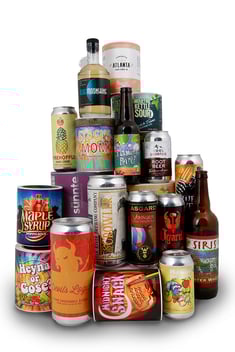 Once again I ventured back to visit our busy Digital Label Presses and did my year-end survey of all the cool labels that we printed in 2021. Weber has some amazing customers that trust us to take their incredible artwork and turn it into labels that will showcase their brand.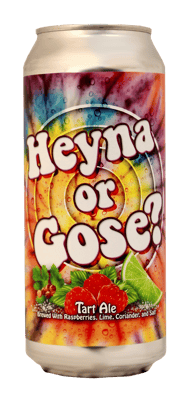
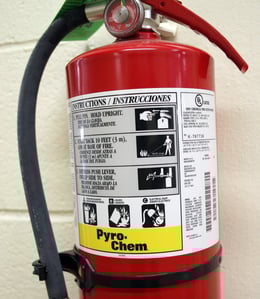 What do automotive parts, power tools, fire extinguishers, electronic components and chemical containers have in common?
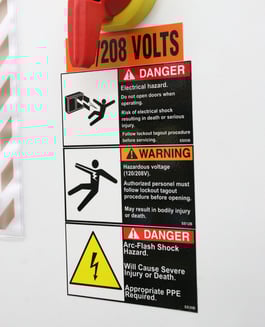 When it comes to durable goods, labels are for life. These labels can include words, pictures, or both, whatever is necessary to identify the contents and their importance. Labels help customers use and maintain their cars, power tools and appliances. And by delivering directions and critical warnings, labels keep people safe.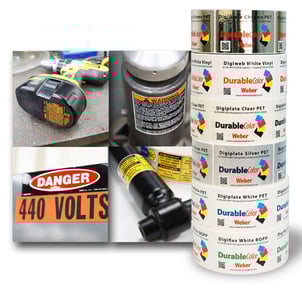
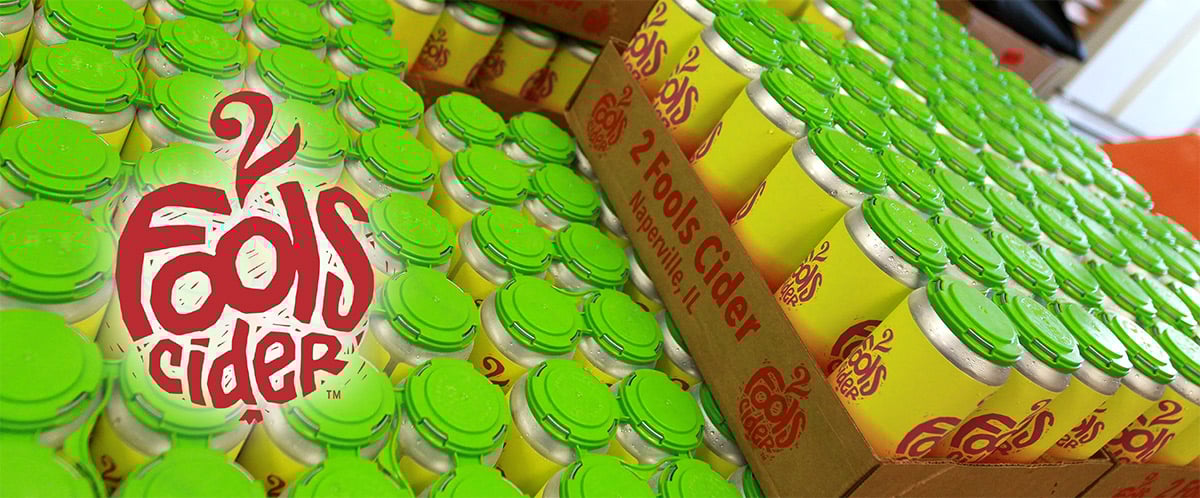
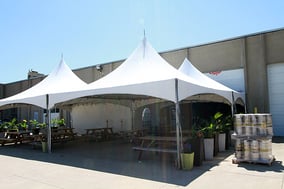 One of the things they did in the early days of the pandemic was to pivot quickly and get an outdoor tent set up so they could remain open. Their outdoor space allowed them to keep serving customers when inside service closed up again in the late Summer of 2020. 2 Fools was lucky to enjoy a lot of local support with both their outdoor taproom and local deliveries of packaged cider that helped them actually grow their business during hard times.
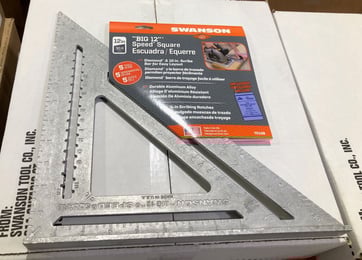 Swanson was approached by one of their customers about a new packaging configuration for two of their largest framing square sizes. Typically, the labeling for these items include a large glossy tagstock material that is stapled or glued together, sometimes with an instructional “blue book” contained within. Because of the odd shape, this is all prepared by hand.
 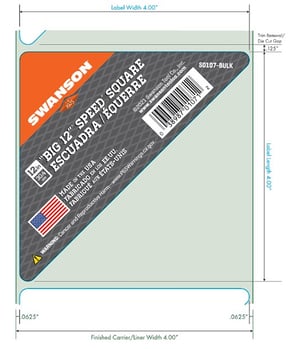 The primary requirement for this label was that it needed to be removable without leaving any residue behind on the high-quality CNC-machined aluminum framing squares that would frustrate the end user. After all, the preferred location of this new label was directly on top of etched distance and angle markings, essential for the use of the product.
 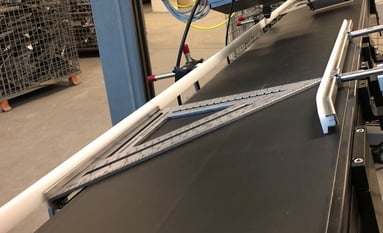 Next, they asked Weber to find a way to automate the labeling process. The idea was to place a triangle-shaped label on the corner of the framing squares, or a triangle-on-a-triangle. The framing squares have an extended base, or bevel, which allows them to nicely rest along side the length of a piece of lumber and be slid up and down to trace lines for cutting.